
Introduction
Vietnam’s rapid transformation into a global manufacturing and export hub has been closely tied to the development of its maritime infrastructure. With a coastline stretching over 3,260 kilometers and a strategic position along key international shipping routes in the South China Sea, Vietnam’s port system plays a central role in facilitating trade, attracting foreign investment, and supporting economic growth.
Over the past decade, the Vietnamese government has made significant efforts to modernize and expand its seaport network in accordance with the Master Plan for Development of Vietnam’s Seaport System to 2030, with a vision to 2050, approved under Decision No. 1579/QĐ-TTg and further refined by Decision No. 442/QĐ-TTg in 2022. These official frameworks aim to transform Vietnam into a strong maritime nation, capable of competing with regional logistics hubs such as Singapore and Malaysia.
This article provides a detailed and up-to-date overview of Vietnam’s port system, including its classification, operational characteristics, strengths and weaknesses, as well as future challenges and development directions. It is designed to support investors, logistics professionals, and businesses seeking to better understand Vietnam’s maritime infrastructure landscape.
Overview of Vietnam’s Seaport System
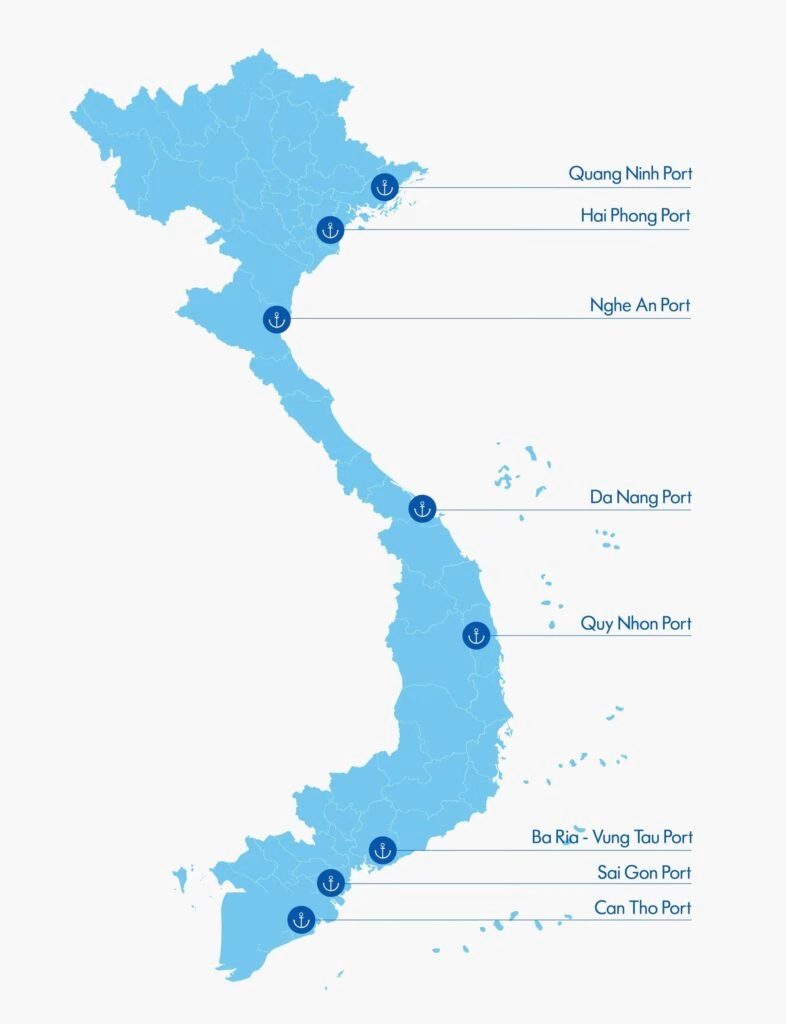
Vietnam currently operates a network of more than 290 terminals across 34 seaports, organized into six major port groups based on geographical regions. These include the Northern region, North Central region, Central Central region, South Central region, Southeast region, and Mekong Delta region.
Key port clusters include the Hải Phòng – Quảng Ninh area in the north, the Đà Nẵng – Quảng Ngãi corridor in central Vietnam, and the Hồ Chí Minh City – Bà Rịa-Vũng Tàu cluster in the south. Among these, the Cái Mép – Thị Vải port complex has gained international recognition as one of the few ports in Southeast Asia capable of handling ultra-large container vessels (ULCVs) with direct routes to Europe and North America.
Vietnam’s seaport system handles hundreds of millions of tons of cargo annually, including containerized goods, bulk commodities such as coal and cement, liquid cargo like petroleum, and agricultural exports such as rice, coffee, and seafood. The system is increasingly integrated with inland logistics networks, including road, rail, and inland waterways.
Classification of Vietnam’s Seaport System after Provincial Mergers
Under current regulations and planning frameworks issued by the Ministry of Transport, Vietnam’s seaports are classified into four categories based on their scale, importance, and role in the national and regional economy.
Special-Class Ports
Special-Class ports are of exceptional importance to Vietnam’s national economy and international trade. These ports serve as major international gateways and are capable of handling large volumes of cargo, including deep-sea container ships.
Prominent examples include the Hải Phòng port complex in the north and the Cái Mép – Thị Vải port cluster in the south. These ports are equipped with modern infrastructure, deep-water berths, and advanced logistics services, allowing them to connect directly with global shipping lines without transshipment through regional hubs.
These ports are often prioritized for government investment and policy support due to their strategic significance.
Class I Ports
Class I ports play a critical role at the regional or inter-regional level. They serve as major hubs for economic zones, industrial parks, and key industries such as energy, manufacturing, and agriculture.
Examples include ports in Đà Nẵng, Quy Nhơn, and Nghi Sơn. These ports typically handle both domestic and international cargo, although their capacity and infrastructure may not match Special-Class ports.
They are essential for supporting regional development and reducing logistics costs for businesses operating outside major economic centers.
Class II Ports
Class II ports primarily serve provincial or local economic activities. They are often smaller in scale and cater to specific industries such as fisheries, construction materials, or local manufacturing.
These ports may not handle large container vessels but are important for ensuring connectivity and supporting local supply chains.
Class III Ports
Class III ports are the smallest category and are typically used for specialized purposes such as oil and gas operations, ship repair, or dedicated industrial use.
They may be privately operated and are not generally involved in large-scale commercial cargo handling.
Characteristics of Vietnam’s Seaports
Strength
Vietnam’s port system benefits from a highly advantageous geographic location. Positioned along one of the world’s busiest maritime routes, the country serves as a natural gateway between East Asia, Southeast Asia, and global markets. This allows Vietnamese ports to attract international shipping lines and serve as key nodes in global supply chains.
Another major strength lies in the rapid modernization of infrastructure. In recent years, significant investments have been made in deep-water ports, container terminals, and logistics facilities. Ports such as Lạch Huyện in Hải Phòng and Cái Mép – Thị Vải in Bà Rịa-Vũng Tàu are equipped with state-of-the-art technology and can accommodate large vessels, reducing reliance on transshipment hubs.
Vietnam also benefits from strong export growth, particularly in sectors such as electronics, textiles, and agriculture. This creates consistent demand for port services and encourages further investment in maritime infrastructure.
Weakness
Despite these strengths, Vietnam’s port system still faces several structural limitations. One of the most significant issues is the lack of synchronization between ports and inland transport infrastructure. Congestion on roads and limited rail connectivity can lead to inefficiencies and increased logistics costs.
Another weakness is the uneven distribution of cargo among ports. While major ports like Hải Phòng and Cái Mép – Thị Vải operate below full capacity in some cases, smaller ports may struggle to attract sufficient cargo volumes.
Additionally, logistics services in Vietnam are still developing, with many companies relying on fragmented supply chains and limited value-added services. This reduces the overall competitiveness of the port system compared to more advanced regional hubs.
Challenges and Opportunities
Challenges
Vietnam’s port system faces increasing pressure from regional competition. Countries such as Singapore, Malaysia, and Thailand have well-established port infrastructure and logistics ecosystems, making it challenging for Vietnam to position itself as a leading maritime hub.
Environmental concerns also present a growing challenge. Port development must balance economic growth with sustainability, particularly in coastal areas that are vulnerable to climate change, rising sea levels, and environmental degradation.
Another key challenge is regulatory complexity. While Vietnam has made progress in simplifying administrative procedures, businesses may still encounter bureaucratic hurdles related to customs, licensing, and port operations.
Future Opportunities
At the same time, Vietnam has significant opportunities to strengthen its port system. The continued shift of global supply chains toward Southeast Asia, particularly under the “China+1” strategy, is expected to increase demand for Vietnamese ports.
Free trade agreements such as the CPTPP and EVFTA are also driving export growth, creating additional cargo volume and encouraging investment in logistics infrastructure.
Digital transformation presents another opportunity. The adoption of smart port technologies, automation, and digital logistics platforms can improve efficiency, reduce costs, and enhance competitiveness.
Development Orientation of Vietnam’s Seaport System
According to the latest government planning documents, Vietnam aims to develop a modern, efficient, and sustainable port system by 2030, with a long-term vision to 2050. The focus is on developing key international gateway ports, improving connectivity with inland transport networks, and enhancing logistics services.
The government is prioritizing investment in major port clusters such as Hải Phòng and Bà Rịa-Vũng Tàu, while also upgrading regional ports to support balanced economic development. Public-private partnerships are being encouraged to mobilize capital and expertise from both domestic and international investors.
Sustainability is also a key priority. Future port development will emphasize green technologies, energy efficiency, and environmental protection to ensure long-term viability.
FAQs
What types of cargo are handled by Vietnamese ports?
Vietnamese ports handle a wide range of cargo, including containerized goods, bulk commodities such as coal and cement, liquid cargo like petroleum and chemicals, and agricultural products such as rice, coffee, and seafood. The diversity of cargo reflects the country’s broad industrial and export base.
What government authorities manage ports in Vietnam?
The management of ports in Vietnam involves multiple authorities. The Ministry of Transport is the primary regulatory body, while the Vietnam Maritime Administration oversees port operations and development. Local People’s Committees also play a role in managing port-related activities within their jurisdictions.
What role do ports play in Vietnam’s supply chain?
Ports serve as critical gateways for both imports and exports, connecting Vietnam’s manufacturing sector with global markets. They facilitate the movement of raw materials into the country and finished goods out to international destinations, making them a central component of the national supply chain.
How do Vietnamese ports connect with industrial zones?
Vietnamese ports are closely linked with industrial zones and economic corridors through road, rail, and inland waterway networks. Many industrial parks are strategically located near major ports to reduce transportation costs and improve efficiency, creating integrated logistics ecosystems that support manufacturing and trade.
Conclusion
Vietnam’s port system is a cornerstone of its economic development and global integration. While significant progress has been made in expanding and modernizing maritime infrastructure, there is still considerable potential for improvement, particularly in connectivity, logistics services, and regulatory efficiency.
As global trade continues to evolve, Vietnam is well-positioned to capitalize on emerging opportunities and strengthen its role in international supply chains. For businesses and investors, understanding the structure, capabilities, and future direction of Vietnam’s port system is essential for making informed strategic decisions in this fast-growing market.
For latest updates, follow us on:
Contact us:
- INFINITY CONNECT UK & VIETNAM
- WhatsApp (The UK): +447989308221
- WhatsApp (Vietnam): +84374639336
- Email: hello@infinityconnect.global
- Website: https://infinityconnect.global