
Introduction
Vietnam continues to position itself as one of the most attractive destinations for foreign direct investment in Asia. With strong GDP growth, a young workforce, and an expanding network of free trade agreements, the country offers significant opportunities for international businesses. However, market entry requires more than commercial readiness—it demands a clear understanding of the legal structures available under Vietnamese law.
Foreign companies typically consider three main options when establishing a presence in Vietnam: a Representative Office, a Branch Office, or a Subsidiary (foreign-invested company). Each structure serves a different purpose and comes with its own legal implications, tax obligations, and operational limitations.
Choosing the wrong structure can lead to compliance risks, unnecessary tax burdens, or restrictions on business activities. This guide provides a detailed, regulation-based comparison to help investors make the right decision.
Comparison of Business Types in Vietnam
Definition
A Representative Office is the simplest form of presence in Vietnam. It is designed primarily for non-commercial activities such as market research, business promotion, and liaison functions. Under Vietnamese regulations, it acts purely as an extension of the foreign parent company without engaging in profit-making operations.
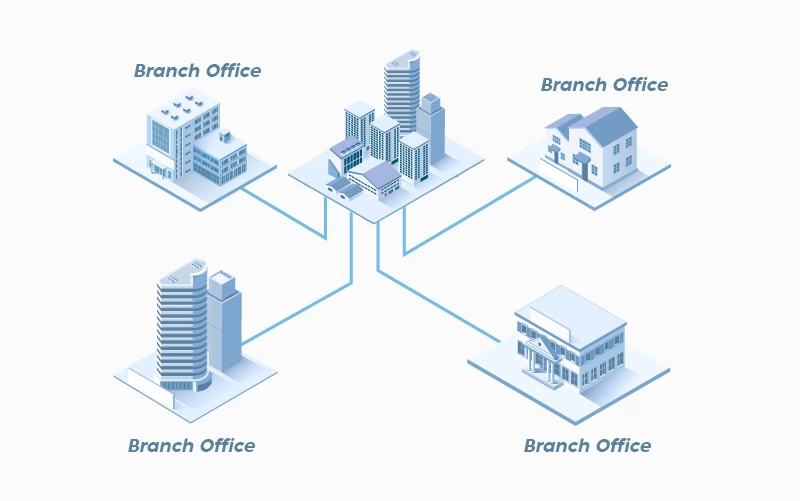
A Branch Office, on the other hand, is a more advanced structure. It is still not an independent legal entity, but it is permitted to conduct certain commercial activities in Vietnam. These activities must fall within the scope allowed by Vietnam’s international commitments and domestic laws, which means not all industries are eligible for branch establishment.
A Subsidiary is a fully incorporated company under Vietnamese law. It is considered a separate legal entity and is typically established as a limited liability company or a joint stock company. This structure allows full participation in business activities, including revenue generation, hiring employees, and entering contracts independently.
Separate Legal Entity
The distinction in legal personality is one of the most critical differences among these structures. A Representative Office and a Branch Office are both dependent units of the foreign parent company. They do not have their own legal identity, which means they cannot operate independently from the parent entity.
In contrast, a Subsidiary is recognized as a separate legal entity under Vietnamese law. It has its own legal status, can own assets, and can take legal action in its own name. This separation provides a level of protection for the parent company that is not available with the other two structures.
Liability
Because Representative Offices and Branches are not independent legal entities, the foreign parent company bears full responsibility for all their activities in Vietnam. Any legal disputes, debts, or liabilities incurred by these entities ultimately fall on the parent company.
A Subsidiary offers a different risk profile. Liability is generally limited to the amount of capital contributed to the company. This makes it a preferred option for businesses seeking to mitigate financial and legal risks while operating in a foreign jurisdiction.
Naming of the Entity
Vietnamese law imposes specific naming conventions for dependent units. A Representative Office must include the name of the parent company followed by its designation and location. A Branch follows a similar structure.
A Subsidiary, however, operates like a local company and must comply with the naming rules under the Law on Enterprises. It can have its own unique name, provided it does not conflict with existing registered businesses.
Contracting
The ability to enter into contracts is a key operational factor. A Representative Office does not have the authority to sign contracts independently. Any agreements must be executed by the parent company, even if negotiations are conducted locally.
A Branch has more flexibility. It can sign contracts within its licensed scope of activities, making it suitable for companies that want to engage in limited commercial operations without establishing a full legal entity.
A Subsidiary has complete contractual autonomy. It can enter into agreements, negotiate terms, and execute contracts in its own name without involving the parent company directly.
Invoice
Invoice issuance is closely tied to revenue generation. A Representative Office is not allowed to issue invoices because it cannot engage in commercial activities.
Both Branches and Subsidiaries can issue invoices in compliance with Vietnamese tax regulations. This enables them to legally receive payments and recognize revenue within the country.
Permitted Activities
The scope of activities varies significantly between the three structures. A Representative Office is restricted to non-commercial functions such as market research, promotion, and liaison work. It cannot directly generate income or participate in business transactions.
A Branch is permitted to conduct commercial activities, but only within sectors that are open to foreign participation. This limitation often makes it less flexible than a Subsidiary.
A Subsidiary enjoys the broadest range of permitted activities. It can engage in manufacturing, trading, and service provision, subject to licensing conditions. This makes it the most versatile structure for long-term business operations.
How Many Weeks to Set Up This Entity Type?
The setup timeline depends on the complexity of the structure. Establishing a Representative Office is relatively straightforward and typically takes around one to one and a half months. The process involves obtaining a license from the relevant authority, usually the Department of Industry and Trade.
Setting up a Branch takes longer due to additional regulatory scrutiny, especially regarding permitted business activities. The process usually ranges from one and a half to two months.
A Subsidiary requires the most time because it involves multiple licensing steps, including obtaining an Investment Registration Certificate and an Enterprise Registration Certificate. The entire process can take two to three months or more, depending on the industry and project scale.
Tax Accounting
A Representative Office has minimal accounting requirements because it does not generate revenue. Its financial obligations are mainly limited to tracking operational expenses and employee-related costs.
Branches and Subsidiaries must comply with Vietnamese accounting standards. They are required to maintain proper accounting records, prepare financial statements, and, in many cases, undergo annual audits. Subsidiaries, in particular, face stricter compliance requirements due to their independent legal status.
Required Taxes
The tax burden varies significantly depending on the structure. A Representative Office is not subject to corporate income tax or value-added tax because it does not conduct commercial activities. However, it must still fulfill obligations related to employee income tax and social insurance.
Branches and Subsidiaries are subject to standard Vietnamese taxes. These include corporate income tax, typically at a rate of 20 percent, and value-added tax, which ranges from zero to ten percent depending on the type of goods or services. Additional taxes may apply depending on the nature of the business.
Tax Obligations
Tax compliance is relatively simple for a Representative Office. It mainly involves employee-related tax filings and periodic reporting to authorities.
Branches and Subsidiaries must comply with a full range of tax obligations, including regular filings for value-added tax and corporate income tax. They are also required to finalize their tax position annually, which involves reconciling all payments and submitting detailed reports to the tax authorities.
Is an Annual Tax Return Filing Required?
A Representative Office does not need to file an annual corporate income tax return because it does not generate taxable income. However, it still has reporting obligations.
Branches and Subsidiaries are required to file annual tax returns. This is a mandatory part of operating a revenue-generating entity in Vietnam and must be completed in accordance with the Tax Administration Law.
Advantages
A Representative Office offers a low-cost and low-risk way to enter the Vietnamese market. It is particularly useful for companies that want to explore business opportunities before making a larger investment. The regulatory burden is relatively light, making it an attractive option for initial market research.
A Branch provides a middle ground. It allows for some level of commercial activity without the need to establish a separate legal entity. This can be beneficial for companies operating in sectors where branches are permitted.
A Subsidiary offers the greatest level of flexibility and control. It enables full participation in the market, including revenue generation and expansion. It also provides limited liability protection and access to investment incentives, making it the preferred choice for long-term operations.
Disadvantages
The main limitation of a Representative Office is its inability to generate revenue. This makes it unsuitable for companies that want to conduct actual business transactions in Vietnam.
A Branch, while more flexible, still lacks legal independence. This exposes the parent company to potential risks and liabilities. Additionally, regulatory restrictions may limit its applicability in certain industries.
A Subsidiary requires a higher level of commitment. The setup process is more complex, and ongoing compliance obligations are more demanding. It also requires capital contribution, which may be a barrier for some investors.
FAQs
Does a company branch have legal personality?
A Branch does not have legal personality under Vietnamese law. It is considered an extension of the parent company, which means all rights and obligations ultimately belong to the parent entity.
Can a representative office generate revenue in Vietnam?
A Representative Office is not allowed to generate revenue. Its role is strictly limited to non-commercial activities such as market research and business promotion. Engaging in profit-making activities would violate Vietnamese regulations.
Can foreign companies convert a representative office into a subsidiary?
Vietnamese law does not provide a direct conversion mechanism. A foreign company must establish a new Subsidiary and then decide whether to maintain or close the Representative Office. In practice, many companies use the Representative Office as a stepping stone before setting up a full legal entity.
Which structure is more suitable for long-term investment in Vietnam?
For long-term investment, a Subsidiary is generally the most suitable structure. It provides full operational capacity, legal independence, and the ability to scale business activities. While it requires greater initial effort and compliance, it offers the strongest foundation for sustainable growth in Vietnam.
Conclusion
Selecting the appropriate business structure in Vietnam is a strategic decision that can significantly impact your success in the market. A Representative Office is ideal for early-stage exploration, a Branch may suit specific operational needs in regulated sectors, and a Subsidiary provides the most comprehensive platform for long-term investment.
Understanding the legal, tax, and operational differences between these options is essential. With the right structure in place, foreign investors can take full advantage of Vietnam’s dynamic and rapidly growing economy while maintaining compliance with local regulations.
For latest updates, follow us on:
Contact us:
- INFINITY CONNECT UK & VIETNAM
- WhatsApp (The UK): +447989308221
- WhatsApp (Vietnam): +84374639336
- Email: hello@infinityconnect.global
- Website: https://infinityconnect.global
 Tiếng Việt