
Introduction
As Vietnam continues to strengthen its position as a global manufacturing and logistics hub, the demand for efficient customs solutions and advanced warehousing models has grown significantly. Among these, bonded warehouses have become an essential component of the country’s trade facilitation system, enabling businesses to store imported goods without immediately paying duties and taxes.
Bonded warehouses are particularly valuable for companies engaged in import-export activities, re-export operations, and international supply chain management. They provide flexibility, cost savings, and compliance advantages that are critical in today’s competitive business environment.
The establishment and operation of bonded warehouses in Vietnam are governed by key legal instruments such as the Law on Customs 2014 (as amended), Decree No. 08/2015/NĐ-CP (as amended by Decree No. 59/2018/NĐ-CP), and Circular No. 38/2015/TT-BTC (as amended by Circular No. 39/2018/TT-BTC). These regulations set out detailed conditions, procedures, and compliance requirements for businesses seeking to operate bonded warehouse facilities.
This article provides a comprehensive and up-to-date guide on how to establish a bonded warehouse in Vietnam, covering legal frameworks, operational requirements, step-by-step procedures, and strategic benefits.
What Is a Bonded Warehouse?
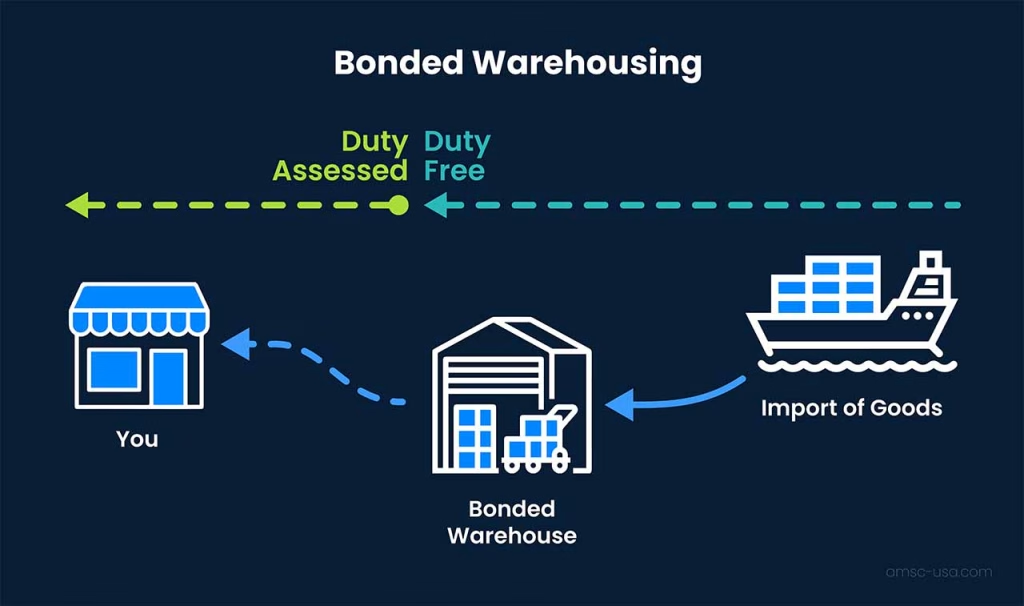
A bonded warehouse is a designated storage facility approved by customs authorities where goods can be stored under customs supervision without the payment of import duties and taxes until they are released for domestic consumption or re-exported.
Goods stored in bonded warehouses are considered to be outside the customs territory for tax purposes. This allows businesses to defer duty payments, manage inventory more efficiently, and optimize cash flow.
Bonded warehouses are commonly used for imported goods awaiting distribution, goods in transit, and products intended for re-export to third countries.
Legal Framework and Authorities Involved
The legal framework governing bonded warehouses in Vietnam is primarily administered by the Ministry of Finance through the General Department of Vietnam Customs. These authorities are responsible for licensing, supervision, and enforcement.
The key regulations include the Law on Customs 2014, which establishes the general principles of customs management, and its implementing decrees and circulars, which provide detailed guidance on bonded warehouse operations.
Local Customs Departments play a direct role in inspecting facilities, monitoring compliance, and managing day-to-day operations of bonded warehouses.
Types of Bonded Warehouses in Vietnam
Vietnam recognizes different types of bonded warehouses depending on their function and location. These may include general bonded warehouses used for storing a wide range of goods, specialized warehouses designed for specific types of cargo such as petroleum or chemicals, and bonded yards for storing oversized or bulk goods.
The classification may also depend on whether the warehouse is located within industrial zones, seaports, airports, or border gate areas.
Types of Goods Allowed and Prohibited in Bonded Warehouses
Goods from Abroad Entering Bonded Warehouses
Imported goods can be stored in bonded warehouses before being distributed in the domestic market or re-exported. These typically include raw materials, machinery, consumer goods, and components used in manufacturing.
Goods from Vietnam Entering Bonded Warehouses
Goods produced in Vietnam may also be placed in bonded warehouses for export purposes. This is particularly common for export-oriented manufacturing enterprises that need temporary storage before shipment.
Goods Prohibited in Bonded Warehouses
Certain categories of goods are prohibited from being stored in bonded warehouses. These include items banned from import or export under Vietnamese law, hazardous materials that do not meet safety standards, and goods that may pose risks to public health, security, or the environment.
Bonded Warehouse Recognition Criteria
Conditions Regarding Location
Bonded warehouses must be located in areas that are convenient for customs supervision, typically near seaports, airports, international border gates, or major logistics hubs. The location must be clearly defined and approved by the customs authority.
Conditions Regarding the Warehouse/Yard
The warehouse must meet technical standards for construction, including adequate storage capacity, proper infrastructure, and suitability for the types of goods to be stored. It must be designed to ensure the safety and integrity of goods under customs supervision.
Conditions Regarding the Area
There are minimum area requirements depending on the type of warehouse. For example, bonded warehouses are generally required to have a minimum area of several thousand square meters, while bonded yards may require larger spaces for bulk cargo.
Conditions Regarding Management Software
Operators must implement a warehouse management system that is capable of tracking goods in real time and integrating with the customs authority’s electronic system. This ensures transparency and facilitates customs control.
Conditions Regarding Security and Surveillance
Strict security measures are required, including fencing, controlled access points, and 24/7 surveillance systems. Cameras must be installed to monitor all key areas, and data must be stored and accessible to customs authorities.
Key Steps to Establish a Bonded Warehouse
Step 1: Submit the Required Documents
The applicant must prepare and submit a dossier to the local Customs Department. This includes an application form, business registration certificate, documents proving land use rights or lease agreements, technical descriptions of the warehouse, and details of the management system.
Step 2: Customs Department Review
The Customs Department will review the application and conduct a physical inspection of the proposed warehouse site. This step ensures that all legal and technical requirements are met.
Step 3: Decision by the General Department of Customs
Based on the inspection results and recommendations from the local Customs Department, the General Department of Customs will issue a decision approving or rejecting the application. If approved, the warehouse will be officially recognized as a bonded warehouse.
Main Benefits of Using a Bonded Warehouse
Deferred Duty Payments
One of the most significant advantages of bonded warehouses is the ability to defer import duties and taxes until goods are released into the domestic market. This improves cash flow and reduces financial pressure on businesses.
Flexibility in Re-Exporting
Bonded warehouses allow goods to be re-exported without incurring import duties, making them ideal for trading companies and regional distribution hubs.
Inventory Management and Value-Added Services
Businesses can use bonded warehouses to manage inventory more effectively, including sorting, packaging, and labeling goods before distribution. These value-added services enhance operational efficiency.
Improved Compliance and Security
Operating under customs supervision ensures a high level of compliance and security, reducing the risk of smuggling, fraud, and regulatory violations.
Common Challenges
Despite their advantages, bonded warehouses also present certain challenges. The initial investment in infrastructure and technology can be substantial, particularly for meeting strict regulatory requirements.
Compliance with customs regulations requires ongoing effort, including regular reporting, inspections, and system integration. Any violations can result in penalties or revocation of the license.
Additionally, the approval process can be time-consuming, especially for new investors unfamiliar with Vietnamese regulations.
Why Vietnam for Bonded Warehouse Solutions?
Strategic Geographical Location
Vietnam’s location along major international shipping routes makes it an ideal hub for regional logistics and distribution.
Robust Economic Growth
Strong economic performance and increasing trade volumes create sustained demand for warehousing and logistics services.
Trade Agreements and Partnerships
Vietnam’s participation in multiple free trade agreements enhances its attractiveness as a logistics hub and facilitates cross-border trade.
Investment-Friendly Policies
The government has implemented policies to attract foreign investment, including improvements in customs procedures and infrastructure development.
Expanding Infrastructure
Significant investments in ports, highways, and industrial zones are improving connectivity and logistics efficiency.
Cost-Effective Operations
Compared to other regional hubs, Vietnam offers competitive labor and operational costs.
Dynamic Business Culture
A growing private sector and entrepreneurial environment support innovation and growth in logistics services.
FAQs
How long can goods be stored in a bonded warehouse?
Under current regulations, goods can typically be stored in a bonded warehouse for up to 12 months, with the possibility of extension in certain cases subject to approval by customs authorities.
Are exports to bonded warehouses eligible for the 0% VAT rate?
Yes, goods exported into bonded warehouses are generally eligible for a 0% VAT rate, provided that all conditions and documentation requirements are met in accordance with Vietnamese tax regulations.
Can ownership of goods in a bonded warehouse be transferred?
Yes, ownership of goods stored in bonded warehouses can be transferred between parties, subject to compliance with customs procedures and proper documentation.
Can foreign investors establish a bonded warehouse in Vietnam?
Yes, foreign investors can establish bonded warehouses, typically through a foreign-invested enterprise, provided they meet all legal and regulatory requirements.
Are bonded warehouses required to be located near ports or border gates?
While not strictly mandatory in all cases, bonded warehouses are generally required to be located in areas that facilitate customs supervision, such as near seaports, airports, or international border gates.
Conclusion
Establishing a bonded warehouse in Vietnam offers significant strategic advantages for businesses involved in international trade and logistics. From deferred duty payments to enhanced supply chain flexibility, bonded warehouses play a crucial role in optimizing operations and improving competitiveness.
However, the process requires careful planning, substantial investment, and strict compliance with regulatory requirements. By understanding the legal framework and following the correct procedures, businesses can successfully establish and operate bonded warehouses in Vietnam, positioning themselves to benefit from the country’s continued growth as a global trade hub.
For latest updates, follow us on:
Contact us:
- INFINITY CONNECT UK & VIETNAM
- WhatsApp (The UK): +447989308221
- WhatsApp (Vietnam): +84374639336
- Email: hello@infinityconnect.global
- Website: https://infinityconnect.global
 Tiếng Việt