
Introduction
Hung Yen Province has rapidly transformed from a primarily agricultural locality into one of Northern Vietnam’s most promising industrial investment destinations. Strategically located in the Red River Delta and adjacent to Hanoi, Hung Yen offers foreign investors a compelling combination of connectivity, infrastructure, competitive costs, and pro-investment policies.
As Vietnam continues to attract strong foreign direct investment (FDI) inflows, provinces like Hung Yen are becoming increasingly attractive alternatives to saturated hubs such as Hanoi and Ho Chi Minh City. With a growing network of industrial parks, streamlined administrative procedures, and strong provincial support, Hung Yen is positioning itself as a key destination for manufacturing, logistics, and high-tech industries.
This in-depth guide provides a complete overview of how to establish a foreign-invested company in Hung Yen Province in 2026, including legal procedures, required documents, competent authorities, and investment opportunities.
Why Register a Company in Hung Yen?
Hung Yen’s rise as an FDI hotspot is driven by several strategic advantages that make it particularly attractive for foreign investors.
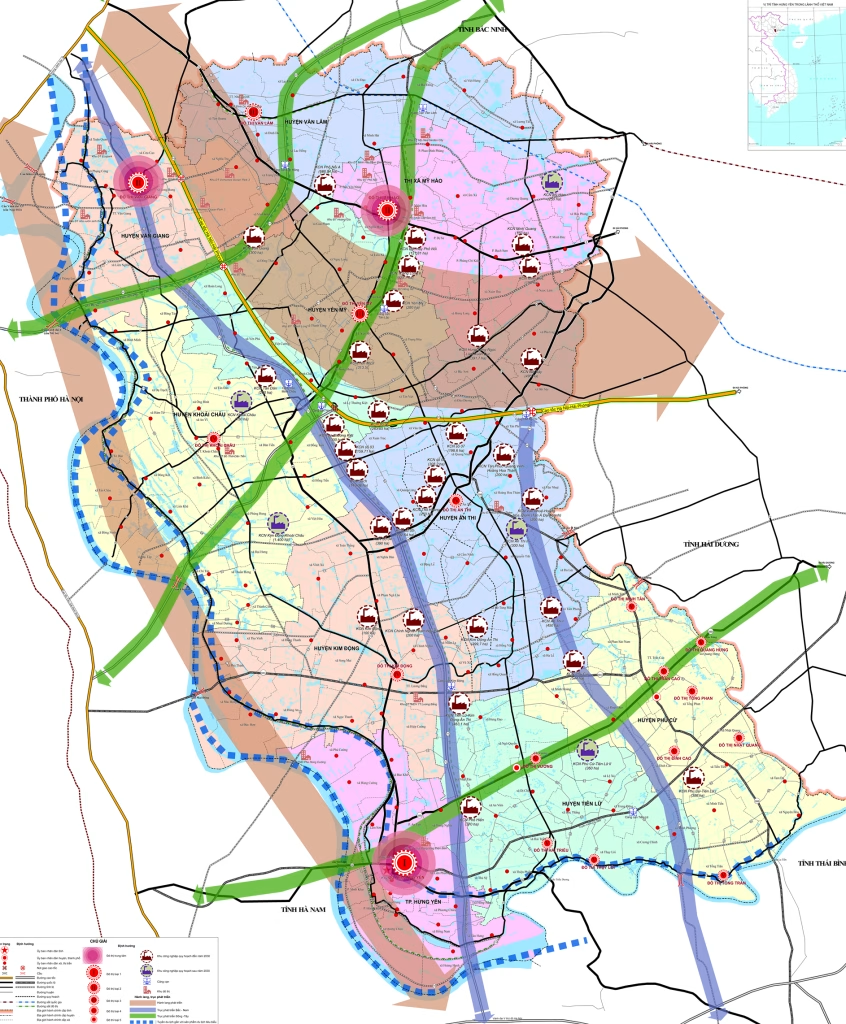
First, its geographic location is a major strength. Situated just 30–50 kilometers from Hanoi and close to major highways, seaports such as Hai Phong, and Noi Bai International Airport, Hung Yen provides excellent logistics connectivity for both domestic distribution and international export.
Second, the province offers a well-developed industrial infrastructure. Over the past decade, Hung Yen has invested heavily in industrial parks (IPs) and industrial clusters (ICs), creating ready-to-use land with modern utilities, including electricity, water supply, and wastewater treatment systems.
Third, Hung Yen maintains competitive land lease costs and labor expenses compared to neighboring provinces like Bac Ninh or Hanoi. This cost advantage is particularly appealing for manufacturing and assembly operations.
Additionally, the provincial government actively supports investors through administrative reforms, simplified procedures, and investment promotion policies. This pro-business environment significantly reduces entry barriers for foreign companies.
Procedures for Establishing a Foreign Invested / FDI Company in Hung Yen
The process of setting up an FDI company in Hung Yen follows the general legal framework applicable throughout Vietnam, primarily governed by the Law on Investment 2020 and the Law on Enterprises 2020. However, local authorities play a key role in implementation.
Application for Investment Policy Approval (if applicable)
Not all investment projects require investment policy approval. This step is only necessary for projects falling under specific categories, such as those involving large-scale land use, environmental impact, or sensitive sectors.
Depending on the nature and scale of the project, approval may be required from the Provincial People’s Committee or higher authorities. Most standard manufacturing or trading projects in industrial parks do not require this step.
Application for the Investment Registration Certificate (IRC)
The Investment Registration Certificate (IRC) is the primary legal document that allows a foreign investor to conduct business activities in Vietnam.
To obtain the IRC, investors must submit an application dossier detailing the investment project, including objectives, scale, capital, location, and implementation timeline. Authorities will assess the feasibility and compliance of the project with local planning and regulations.
Application for the Enterprise Registration Certificate (ERC)
After obtaining the IRC, the investor must apply for the Enterprise Registration Certificate (ERC), which legally establishes the company as a business entity in Vietnam.
The ERC includes essential information such as company name, registered address, charter capital, legal representative, and business lines.
Post-establishment Process
Once the company is officially established, several post-licensing procedures must be completed. These include opening a corporate bank account, registering for taxes, obtaining a company seal, and fulfilling labor and social insurance obligations.
Depending on the business sector, additional licenses or permits may also be required before commencing operations.
Authorities Responsible for Issuing Certificates
Department of Planning and Investment of Hung Yen Province
The Department of Planning and Investment (DPI) is the primary authority responsible for processing investment and enterprise registration applications for projects located outside industrial parks.
It plays a central role in evaluating investment proposals, issuing IRCs and ERCs, and guiding investors through the registration process.
Hung Yen Industrial Zone Management Board
For projects located within industrial parks, the Hung Yen Industrial Zone Management Board acts as the licensing authority. It is responsible for issuing IRCs and overseeing investment activities within industrial zones.
This decentralized mechanism allows for faster processing and more specialized support for industrial projects.
Business Registration Office
The Business Registration Office, under the DPI, is responsible for issuing Enterprise Registration Certificates and maintaining the national business registration database.
Dossiers for Establishing a Foreign Invested Company (FDI) in Hung Yen
A Dossier for Granting an Investment Registration Certificate
The IRC application dossier typically includes a written request for project implementation, proof of legal status of the investor, financial capacity documentation, and a detailed investment proposal.
The proposal should clearly outline the project’s objectives, scale, investment capital, location, duration, and labor requirements. In some cases, additional documents such as land use agreements or technology explanations may be required.
A Dossier for Granting an Enterprise Registration Certificate
The ERC dossier includes the company charter, list of members or shareholders, identification documents of the legal representative, and the application form for enterprise registration.
For foreign investors, all documents issued abroad must be legalized and translated into Vietnamese in accordance with local regulations.
Industrial Parks in Hung Yen in 2026
Hung Yen Province has developed a robust network of industrial parks that cater to various industries and investment scales. These industrial parks are equipped with modern infrastructure and are strategically located along major transportation routes.
Notable industrial parks include Pho Noi A Industrial Park, Pho Noi B Industrial Park, Thang Long II Industrial Park, and Yen My II Industrial Park. These parks have attracted significant FDI from countries such as Japan, South Korea, and Europe.
The availability of ready-built factories and flexible land lease options makes these industrial parks particularly attractive for foreign investors seeking quick market entry.
Key Sectors for Investment in Hung Yen’s Industrial Zones
Hung Yen has identified several priority sectors for investment, aligning with its economic development strategy.
The automotive, mechanical, and agricultural machinery manufacturing sector is a major focus, supported by the presence of supporting industries and skilled labor.
Electronics and information technology are also rapidly growing sectors, benefiting from Vietnam’s integration into global supply chains.
Biotechnology and high-tech agriculture are emerging areas, reflecting the province’s efforts to modernize its agricultural base.
Consumer goods and household appliances manufacturing continue to attract investment due to strong domestic demand.
Building materials production is another key sector, supported by the region’s construction growth.
Industrial synthesis, including multi-sector manufacturing and supporting industries, plays an important role in enhancing the province’s industrial ecosystem.
Potential from Industrial Clusters of Hung Yen Province (ICs)
In addition to industrial parks, Hung Yen is developing industrial clusters (ICs) to support small and medium-sized enterprises.
Industrial clusters are typically smaller than industrial parks and are designed to accommodate local businesses and supporting industries. They provide basic infrastructure and are often located closer to residential areas.
For foreign investors, industrial clusters can offer cost advantages and opportunities to collaborate with local suppliers. However, infrastructure and regulatory conditions may vary compared to larger industrial parks.
FAQs
What Investment Incentive Policies Are Offered for Investing in Hung Yen IPs?
Investors in Hung Yen’s industrial parks may benefit from various incentives, including corporate income tax reductions, tax holidays, and exemptions or reductions in land lease fees.
The specific incentives depend on the project’s sector, scale, and location, particularly whether it falls within encouraged industries or disadvantaged areas.
What Is the Difference Between an Industrial Park (IP) and an Industrial Cluster (IC) in Hung Yen?
Industrial parks are larger, more developed zones with comprehensive infrastructure and are often designed for large-scale industrial projects and foreign investment.
Industrial clusters, on the other hand, are smaller and typically cater to local enterprises and supporting industries. They may have lower costs but also less advanced infrastructure.
Can Foreign Investors Hold 100% Ownership?
Yes, foreign investors can generally hold 100% ownership of a company in Hung Yen, depending on the business sector. Vietnam has liberalized many industries, allowing full foreign ownership under its international commitments.
However, certain conditional sectors may impose restrictions or require joint ventures with local partners.
How Long Does It Take to Register a Company in Hung Yen?
The timeline for establishing an FDI company in Hung Yen typically ranges from 15 to 30 working days, depending on the complexity of the project and the completeness of the application dossier.
Projects requiring investment policy approval may take longer due to additional review procedures.
Conclusion
Hung Yen Province stands out as a highly attractive destination for foreign direct investment in Vietnam. With its strategic location, competitive costs, expanding industrial infrastructure, and investor-friendly policies, it offers significant opportunities for businesses seeking to establish a presence in Northern Vietnam.
Setting up an FDI company in Hung Yen involves a structured legal process, from obtaining the Investment Registration Certificate to completing post-establishment procedures. While the process is relatively straightforward, careful preparation and compliance with legal requirements are essential for success.
For investors looking to tap into Vietnam’s growing economy, Hung Yen represents not just an alternative location, but a strategic gateway to sustainable growth and long-term investment potential.
For latest updates, follow us on:
Contact us:
- INFINITY CONNECT UK & VIETNAM
- WhatsApp (The UK): +447989308221
- WhatsApp (Vietnam): +84374639336
- Email: hello@infinityconnect.global
- Website: https://infinityconnect.global
 Tiếng Việt